
The Fesánti Regeneration Curve™
Every family is always in a transition, at its beginning, its middle or its close.
Locate where your family stands today, and where that position leads.
Request an introduction Locate your family
By introduction and recommendation. Every conversation is held in confidence.
The Fesánti Regeneration Curve™ reads a family on three measures: the structure laid for it to move across, the capability built at every level beneath it, and the lived governance that keeps both in use.
1
The Position
The Position shows where a family and its enterprise stand on structure, capability and governance today.
2
The Trajectory
The Trajectory shows what that position becomes over the generations that follow, and the gap that opens, generation by generation, between a family with all three in place and a family with only one or two.
Three questions
Three questions locate any family.
Across: the structure
Is the structure laid down for the family and the enterprise to move across every change, new leadership included?
Transition, from transitio: a going across.
Upward: the capability
Is the capability built into every level, rather than held by a few people?
Succession, from succedere: to go up from under.
Holding both: lived governance
Are the policies and practice that keep the structure in use and the capability held, across all six infrastructures, in place?
Governance, from kybernan: to steer a ship.
1The Position
Where the family and the enterprise stand today
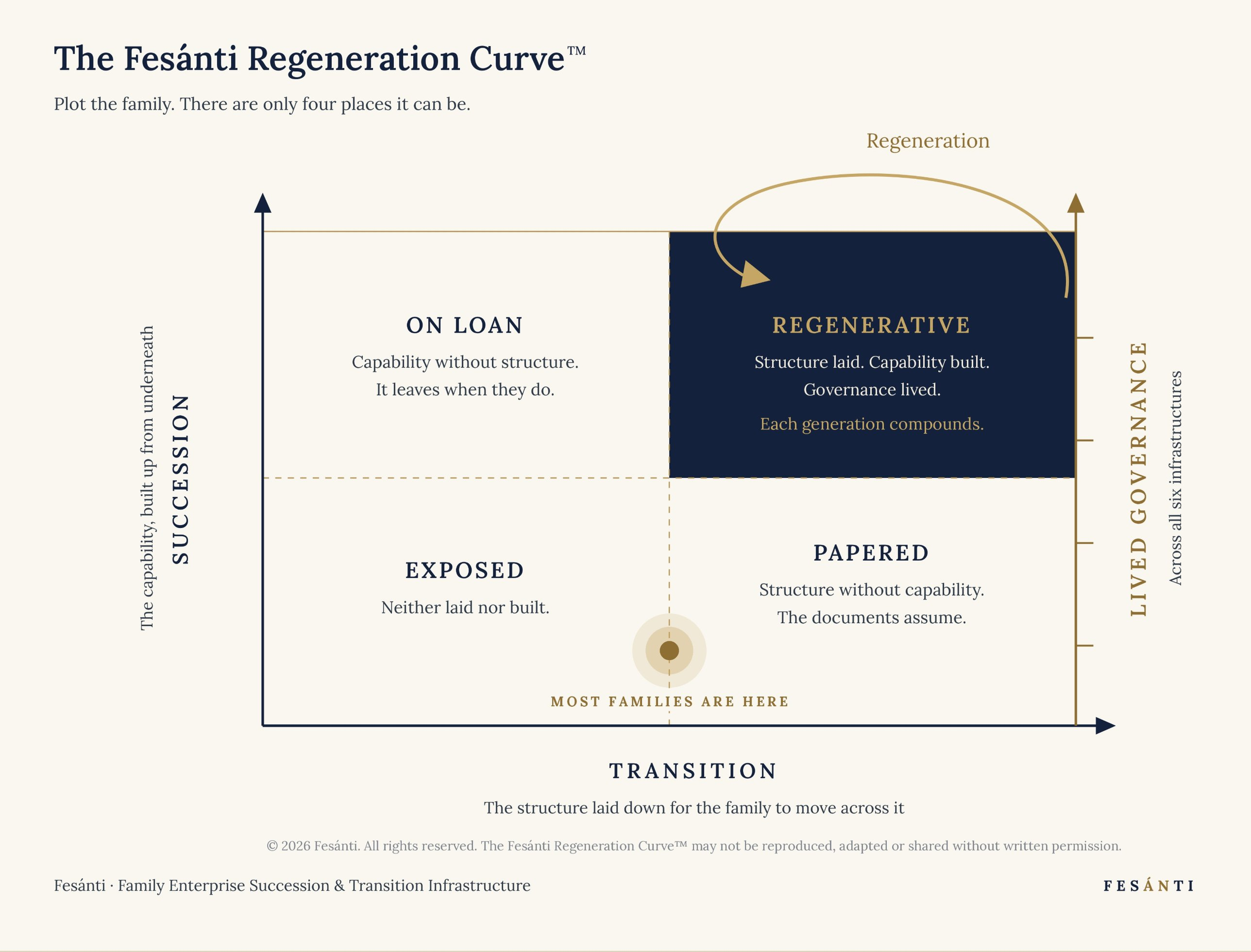
Many families sit on the line between Exposed and Papered.
The four places
Inside each position.
On loan
Capability without structure. It leaves when they do.
33% of family offices name over-reliance on key individuals or providers as a top-three risk to their continuity.J.P. Morgan Private Bank, 2026
The structure holds the assets. A few individuals hold the leadership. The capability is real, and it belongs to the people who carry it rather than to the enterprise. How they decide, how they lead and the conversations only they know how to hold are rarely installed in the seat, only hoped for in the person. To the family, it is on loan.
This is Erosion by Departure. Sooner or later, people move on, and what they carry leaves with them: the knowledge, the experience, the nuances and the relationships. When the leader at the top changes, the value of the enterprise tends to fall, whoever takes over, from within the family or beyond it. The leadership was borrowed, and it comes due when the enterprise can least afford it.
You may recognise this if each role is set out on paper, yet what it takes to lead in it lives only in the person who holds it now.
Papered
Structure without capability. The documents assume.
82% of family businesses have a succession plan in place, yet only 37% are highly confident the next generation is prepared to succeed.Deloitte Private, 2026
The will, the trusts, the constitution and the succession plan each have their place. The documents are signed, so the family believes it is protected. The succession plan is filed, so it believes it has succession. The plan names one individual for the top position. It assumes the capability to take it on, carry it and grow it, at every level beneath the top. A document can record a decision, but it cannot make one.
This is Erosion by Assumption. When the unexpected happens, every document the family holds is fully in force, and not one of them can hold a conversation. The decisions they were written to settle are still waiting to be made, by people who have yet to make them together, and the value of the enterprise waits with them. The next generation inherits the documents, and the decisions with them. Paper isn’t protection. Infrastructure is.
You may recognise this if the documents say who decides, and the family has yet to see those decisions made without the person who holds them now.
Exposed
Neither laid nor built.
86% of family offices do not have clear succession plans for their decision makers, and just 27% have an organised process to prepare the next generation.J.P. Morgan Private Bank and UBS, 2026
The enterprise has been built, and the attention has rightly gone into operating and expanding it. The structure to move through a transition is still to be laid, and the capability beneath the people who lead the family and the enterprise is still to be built. Many families see their transition as something ten or thirty years away, yet every family is already in one.
This is Erosion by Default. Holding still doesn’t keep a family where it is. It chooses the outcome, quietly, by default. A single life event can reach the family, the enterprise and the wealth at once, with nothing laid to carry them through it. A family that is not being built across the generations is being lost across them.
You may recognise this if succession is the conversation the family keeps meaning to have.
Regenerative
Structure laid. Capability built. Governance lived. Each generation compounds.
23 points higher shareholder returns when a handover to a family CEO succeeds. Just over a third of family businesses create value through a change of CEO.McKinsey & Company, Passing the Baton
The structure is in place for every change, capability runs through every level of the family and the enterprise, and lived governance keeps both in use. Each individual has clarity on who they are. Every difference of view has an agreed route through, so the family stays together and knows where it ends and the enterprise begins. Leadership is installed in the seat, so the strongest people move up whenever the enterprise needs them, with someone prepared behind them. A change at the top adds value instead of costing it, and leadership stands as an asset the family holds outright.
This is Generational Sovereignty: the family directs its own transition, and every one after it. Each transition builds on the one before, and the family’s wealth compounds through every one. Those who come next inherit infrastructure and capability, not just capital.
You may recognise this if the family’s governance is lived in every decision, and any change, at any level, is one the family and the enterprise move through together.
Wherever a family stands today,
its trajectory is still being drawn.
2The Trajectory
What each position becomes,
generation after generation
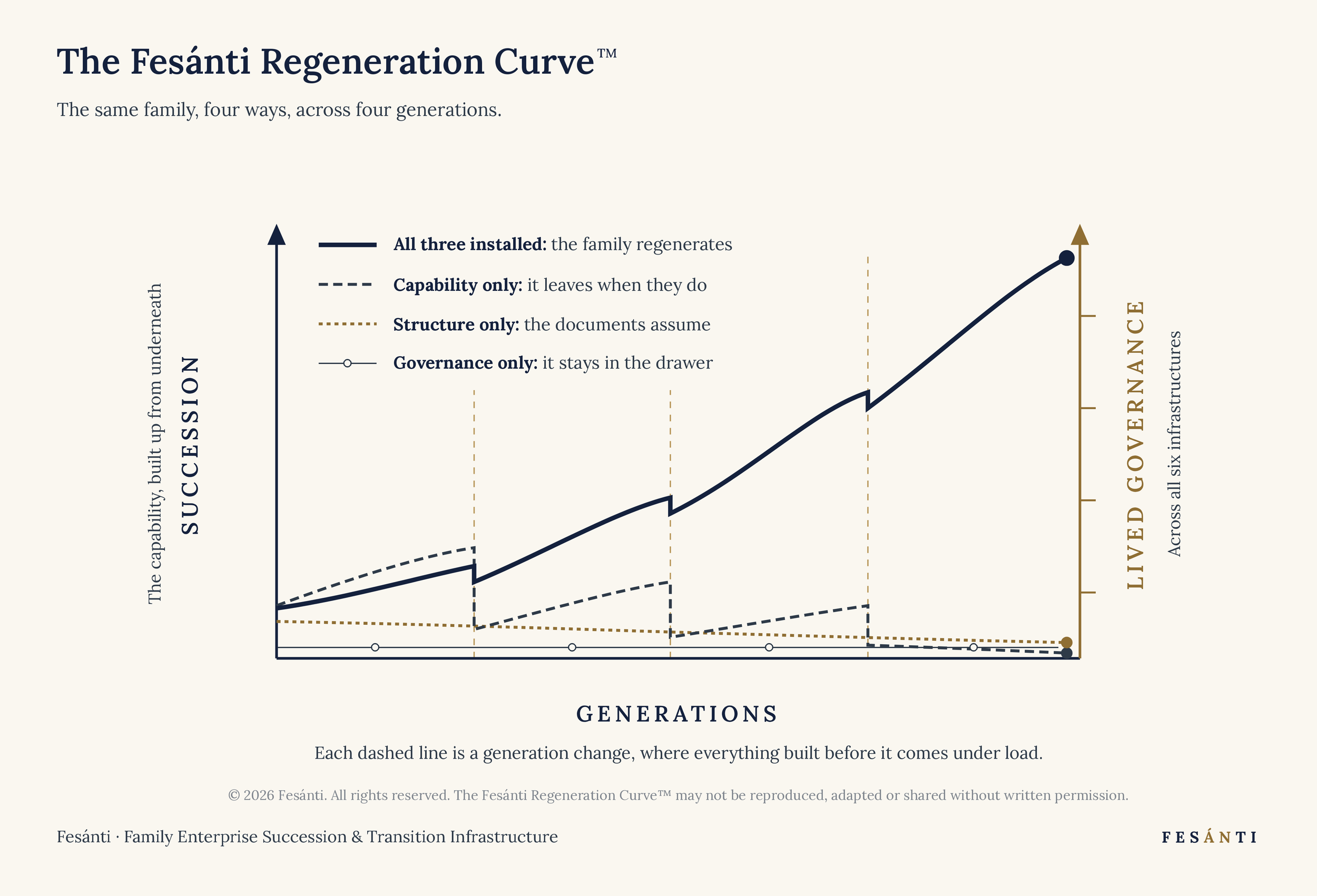
Each dashed line marks a change of generation, the moment everything built before it is put under load.
Reading the Trajectory
Four lines, four outcomes.
Capability only
It climbs while the people who hold it are there, and falls each time they go.
Structure only
The platform is laid, and nothing rises on it. The documents stand while the family slowly declines beneath them.
Governance only
The policies are agreed, then stay in the drawer, with no structure for them to steer and no capability to carry them.
All three installed
Each change of generation registers as a small notch, then compounds. Every generation starts higher, on the ground the last one laid, and puts it to work on whatever it builds next.
The gap between them widens with every generation.
Which line is your family drawing?
Regenerate comes from the Latin regenerare, “to bring forth again”. Generare shares the same root as “generation”, so regeneration literally means bringing each generation forth again. Here, each evolves and builds upon the last. Those who come next inherit infrastructure and capability, not just capital.
Moving along the Curve
A family moves along the Curve as the infrastructure is installed.
Fesánti starts where the immediate fracture is and builds out from there, drawing on the six infrastructures, so it is repaired at source and built to hold across every generation. They install three things: the structure to move through every transition, the capability at every level to take it on, and the lived governance that keeps both in use.
What is installed remains with the family. Each generation inherits it, returns to it as life changes, and puts it to work on whatever it builds next.
Fesánti works with a small number of families, by introduction and recommendation, and with the multi-family offices and partner institutions that serve them.
Others preserve.
Fesánti regenerates.
Questions families ask
What is the Fesánti Regeneration Curve™?
A way to plot any family by two things: the structure laid down for it to move across every transition, and the capability built up from underneath for succession, held in place by lived governance. Where the two meet shows which of four places the family sits in: On loan, Papered, Exposed or Regenerative.
How is it different from the three-circle model of family business?
The three-circle model, developed by Tagiuri and Davis at Harvard, maps the roles people hold across family, ownership and business. The Curve plots whether the structure and capability are installed for the family to move through every transition. One shows who sits where. The other shows whether it holds.
Is family wealth really gone by the third generation?
The widely quoted "shirtsleeves to shirtsleeves in three generations" figure traces back to a 1987 study of 200 Illinois manufacturing businesses, where a sale counted as failure. The Curve shows something more useful: families with structure, capability and lived governance installed build higher with each generation.
What does it mean for a family to be papered?
The family holds the documents, such as a will, trusts, a constitution or a succession plan, and believes it is protected. The capability those documents assume is still to be built.
Where do most families sit?
Many sit on the line between Exposed and Papered: some documents in place, the capability still to be built.
How does a family move along the Curve?
By installing the infrastructure that is missing, starting where the most immediate fracture is and building out from there.
© 2026 Fesánti. All rights reserved. The Fesánti Regeneration Curve™ may not be reproduced, adapted or shared without written permission.